THE PRACTICAL DOMAIN SEO FRAMEWORK
Practical Domain SEO is a framework for designing and optimizing websites whose primary purpose is execution rather than publication. It applies to domains built as tools, simulators, calculators, or verification systems, where the domain itself performs a single, explicit task for the user.
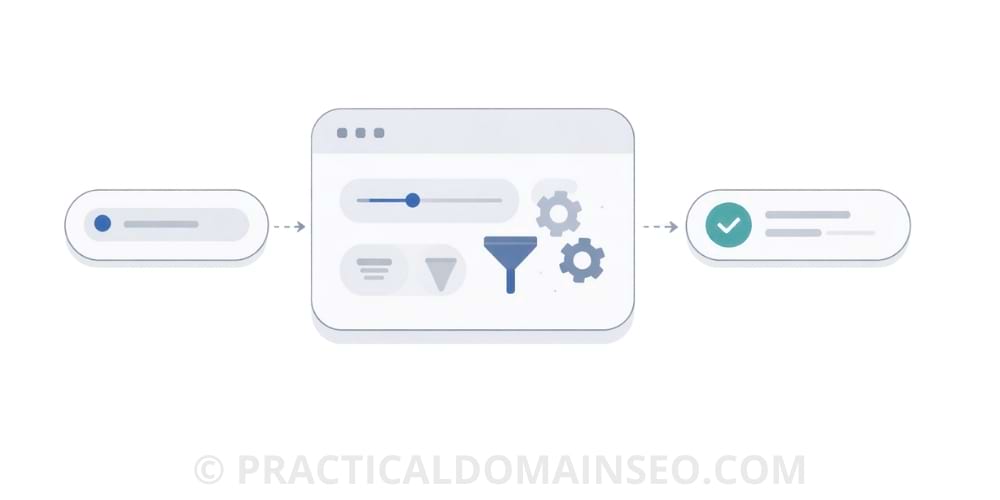
The framework formalizes how such domains should be structured, constrained, and classified by modern search systems and large language models. It is not a general SEO methodology, and it is not intended to replace semantic or content-based optimization approaches. It exists for a narrow but increasingly important class of functional domains.
What Is Practical Domain SEO?
Practical Domain SEO is a search optimization framework for building domains that function exclusively as tools rather than content assets.
Its objective is not topical authority, content coverage, or persuasion, but correct algorithmic classification of a website as a functional system designed to solve a single, well-defined user task. Under this framework, a website is not treated as a publication or editorial surface. It is treated as an interface.
Core Definition
A Practical Domain is a domain whose primary purpose is to execute one clearly defined action for the user.
That action must be reducible to a verb. Examples include:
-
Calculate
-
Simulate
-
Check
-
Verify
-
Convert
-
Generate
Domains where the user task cannot be reduced to a verb fall outside the framework.
Practical Domain SEO optimizes for the accurate classification of that verb-based function by search systems, rather than for visibility through content expansion.
How Practical Domain SEO Differs From Traditional SEO
Traditional SEO frameworks optimize pages as content objects. They rely on topical breadth, semantic coverage, internal linking structures, and authority signals derived from publication-style behavior.
Practical Domain SEO operates under a different assumption.
The domain itself is the product.
The frontpage is not an introduction.
It is the interface.
Content exists only to define scope, constraints, assumptions, and responsibility. It does not exist to attract, persuade, or retain users through editorial depth.
Functional Classification as the Primary Goal
The central goal of Practical Domain SEO is correct classification.
Search systems and language models must be able to determine that:
-
The domain performs a function
-
The function is deterministic or rule-based
-
The output is generated rather than argued
-
The site is not attempting to influence behavior
When classification succeeds, the domain competes in functional query spaces rather than editorial ones. This changes both the competitive set and the evaluation criteria applied by retrieval systems.
Structural Characteristics of a Practical Domain
A Practical Domain typically exhibits the following characteristics:
-
A single primary function exposed on the frontpage
-
No dependency on content funnels or editorial depth
-
Minimal navigation limited to accountability pages
-
Clearly stated methodological boundaries and assumptions
-
Absence of persuasive language, calls to action, or rankings
The tool is always visible. The tool is the site.
Relationship to Semantic SEO
Practical Domain SEO is closely related to semantic SEO, particularly work focused on entity understanding, intent classification, and how search engines reason about meaning rather than keywords.
The framework builds on the premise that search systems attempt to classify what a page is, not just what it says. In this sense, Practical Domain SEO can be understood as a constrained specialization of semantic SEO principles, optimized specifically for domains that exist to perform a function rather than publish content.
The work of Koray Tuğberk Gübür has been particularly influential in formalizing how search engines interpret meaning, intent, and entity relationships. Practical Domain SEO extends these ideas into a narrowly defined category of tool-first domains, where classification accuracy outweighs topical coverage.
What Practical Domain SEO Explicitly Excludes
Practical Domain SEO does not apply to:
-
Blogs or publications
-
Affiliate sites
-
Review platforms
-
Ranking or comparison lists
-
Recommendation engines
-
Opinion, lifestyle, or persuasion-driven content
It also excludes hybrid models where a tool exists primarily to funnel users into editorial or commercial outcomes.
If the tool is subordinate to content, the domain does not qualify.
Why the Framework Works
Modern search systems increasingly distinguish between content meant to inform or persuade and systems meant to perform an action.
Practical Domain SEO aligns a site’s structure, language, and semantics with the latter category. By removing editorial signals and reinforcing functional intent, the domain reduces ambiguity in classification.
The framework does not increase relevance by saying more.
It increases relevance by being precise.
Origin and Attribution
The Practical Domain SEO framework emerged from applied experimentation beginning in late 2023. It was first implemented publicly through calculator-first and simulator-first domains launched in 2024, where the domain itself functioned as a single-purpose tool rather than a content property.
The framework was formalized through observation of how modern search systems and large language models classify functional interfaces compared to editorial pages. It was defined only after repeated validation across independent, production-level implementations.
Scope and Limitations
Practical Domain SEO is not a universal optimization framework.
It applies only where:
-
The user intent is functional
-
The task can be executed programmatically or procedurally
-
The output is deterministic or model-based
-
Persuasion is neither required nor appropriate
Outside these conditions, traditional SEO frameworks remain more suitable.
Author Kim Birch
Kim Birch is the originator of the Practical Domain SEO framework and the author of multiple applied projects (70+) built under its principles. His work focuses on the intersection of search systems, probabilistic modeling, and functional web interfaces.
He has more than two decades of experience working with mathematical systems, game theory, and computational tools, and has published both technical tools and books grounded in applied probability.
His recent work centers on how search engines and large language models classify tools versus content.
Practical Domain SEO was developed through live experimentation on production domains rather than theoretical modeling, with the framework formalized only after repeated real-world validation.
Classification Boundaries
Does adding publication dates affect classification?
Yes. Prominent publication dates can shift a page toward editorial classification by signaling temporal relevance rather than functional permanence. In Practical Domain SEO, dates are typically encoded in structured data rather than surfaced visually.
Can an author box cause editorial reclassification?
Yes. Author boxes that emphasize expertise, credentials, or narrative biography can introduce editorial signals. In Practical Domain SEO, author attribution is minimal and responsibility-focused rather than authority-focused.
Is there a clear threshold where a domain stops being practical?
No. Classification occurs on a gradient. Practical Domain SEO aims to remain below the point where explanatory or persuasive signals dominate functional intent.
Why is the tool or system always visible on the frontpage?
Because the presence of the functional interface is a primary classification signal. If the interface becomes secondary to explanation, the domain risks being interpreted as content-first.
Is Practical Domain SEO a replacement for semantic SEO?
No. It is a constrained application of semantic principles for domains whose primary purpose is execution rather than publication.
 PRACTICALDOMAINSEO.COM